Currently Empty: $0.00

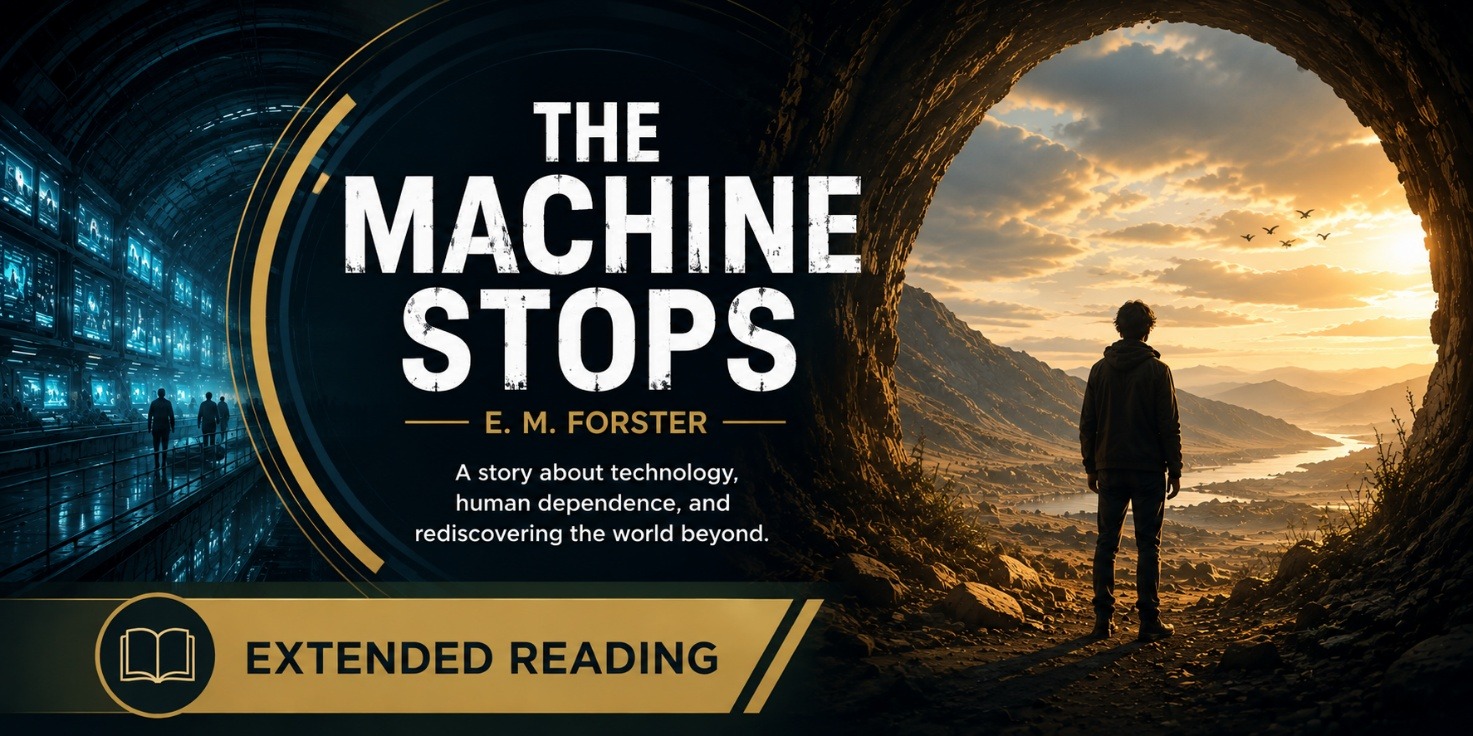
How can we stay connected without losing control of our time and attention?
Genre: Dystopian Science Fiction
Text Structure: Narrative
Main Reading Skill: Analyze Plot Development
Vashti sat alone in a small underground room without windows. Yet she did not consider herself isolated. A glowing screen connected her to thousands of people, while the Machine supplied almost everything she needed—food, music, information, fresh air, and entertainment. People had become so dependent on the system that few travelled or met face-to-face. Why should they, when the Machine could carry a person’s voice and image anywhere?
One day, a light flashed on Vashti’s wall. Her son Kuno was calling.
“I want you to come and see me,” he said.
Vashti stared at his image. “But I can see you now.”
“I need to speak to you without the Machine.”
Vashti was reluctant. Travelling seemed unnecessary and uncomfortable. Yet something in Kuno’s expression made her pause. He refused to explain further, and eventually she agreed to visit him.
The journey unsettled her. On the airship, Vashti avoided looking at the Earth below. Human beings had moved underground generations earlier, exchanging an unpredictable natural world for the safety and convenience of the Machine. Most now regarded the surface as useless.
When Vashti reached Kuno’s room, he wasted no time.
“I have been outside.”
She stared at him. Going to the Earth’s surface without permission was forbidden.
Kuno explained that he had grown tired of experiencing the world indirectly. His knowledge of mountains, oceans, and the sky was always mediated by the Machine through lectures, recordings, and images. He knew what thousands of places looked like, yet he had never truly experienced any of them.
Secretly, he had discovered an old tunnel and begun climbing toward the surface. His body, weakened by years of little physical activity, resisted every movement. The darkness seemed endless, and several times he nearly turned back.
Then he saw daylight.
For the first time, there was no ceiling above him and no screen between him and the sky. Wind struck his face. Rough earth pressed beneath his hands. The open space frightened him, yet he felt more alive than he ever had underground.
Vashti listened with growing alarm.
“The Machine gives us everything we need,” she said. “Why risk your life for this?”
“The danger,” Kuno replied, “is that we have forgotten how to live without it.”
Vashti chose to dismiss his warning. She returned home, where the familiar hum of the Machine soon made Kuno’s fears seem distant.
Then small problems began to appear.
Music sounded strange. Beds stopped working properly. The air occasionally seemed less fresh. People reported each malfunction, expecting immediate repairs. Instead, the problems lasted longer and appeared more often.
Still, almost no one was seriously concerned. The Machine had supported their civilization for generations. Its failure seemed impossible.
Then, without warning, Vashti’s screen went black.
Across the underground world, voices vanished in the middle of conversations. Lights flickered. Information stopped flowing. People demanded repairs, but few understood the systems well enough to make them.
In the sudden silence, Kuno’s words returned to Vashti: We have forgotten how to live without it.
The lights failed completely. The air grew warm and heavy. Food systems stopped functioning. Behind the walls, the steady hum of machinery became an uneven groan. Fear replaced confidence as people called desperately for help.
There was no one to answer.
Their world began to collapse.
Walls shook, machinery broke apart, and darkness filled the rooms that had once seemed perfectly safe. Vashti finally understood the consequences of complete dependence. The Machine had been created to serve humanity, yet people had gradually built their entire existence around it.
Amid the destruction, Vashti found Kuno again. The screens that had connected millions were useless, but mother and son now stood together.
Vashti looked directly into his face.
“I did not understand,” she whispered.
Kuno reminded her that beyond the underground walls, the natural world still endured. The Machine might disappear, but the sky, wind, and open land remained.
Vashti thought of the surface she had once considered useless. Technology had carried voices across enormous distances and placed endless information within reach. But somewhere along the way, convenience had become dependence, and connection had begun to replace experience.
For the first time, no screen stood between Vashti and her son.
Above them, beyond the broken machinery, the Earth remained.
And now she understood why that mattered.