Currently Empty: $0.00

How can images tell stories and influence the way we understand people, events, and the world around us?
Genre: Informational Text
Text Structure: Compare and Contrast
Main Reading Skill: Compare and Contrast
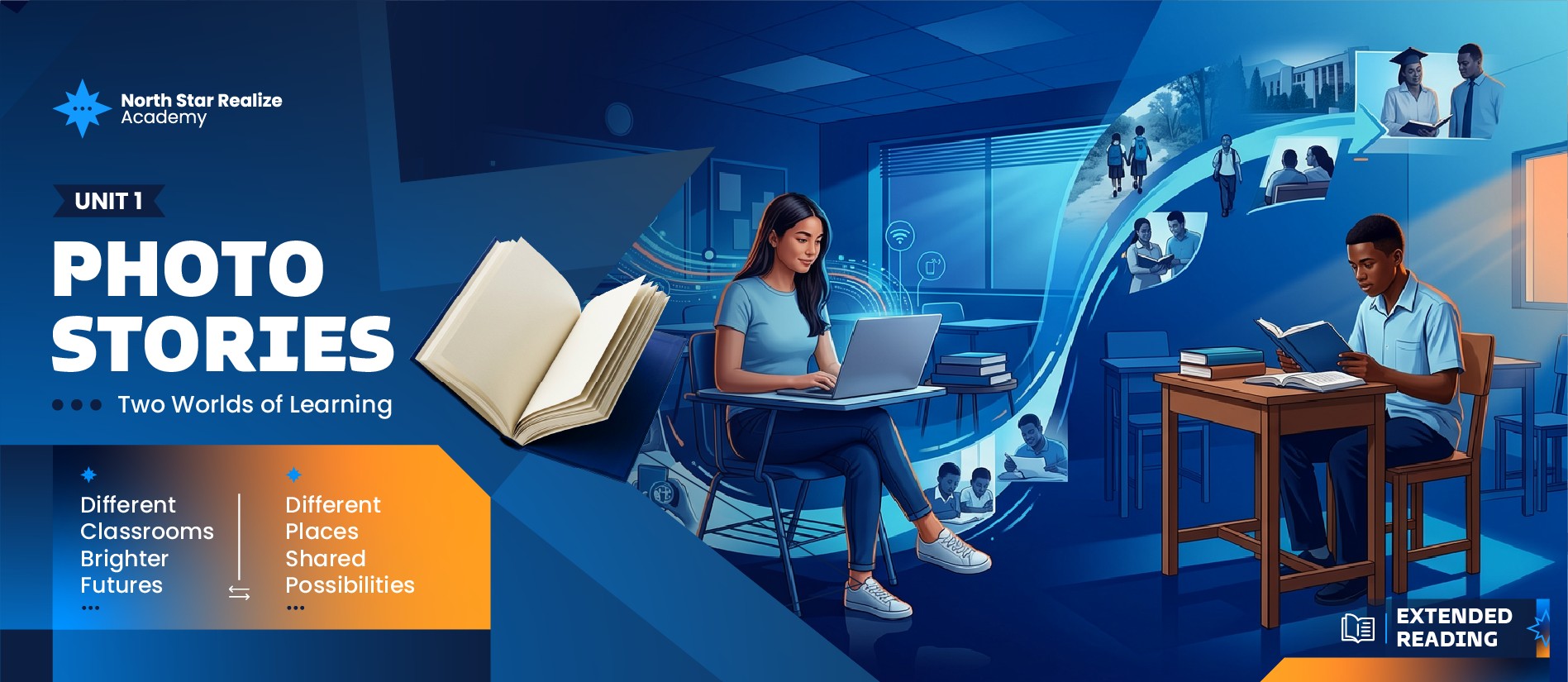
Education can provide learners with knowledge, skills, and opportunities, but the environments in which learning takes place vary greatly. Some learners attend schools with reliable technology, extensive learning materials, and comfortable facilities. Others study in communities where educational resources are more limited. These differences do not determine intelligence, motivation, or potential. However, they can influence how easily learners obtain information, participate in educational activities, and discover future opportunities. Comparing these environments can increase our awareness of the ways educational conditions shape the experience of learning.
One of the clearest differences involves access to information and educational resources. In well-equipped schools, learners may have reliable internet connections, individual or shared digital devices, libraries, laboratories, and a wide range of learning materials. Such resources provide several ways to engage with a subject. A teacher might use a video to introduce a scientific process, an interactive activity to capture learners’ attention, or an online resource to prompt further investigation. If learners find a concept difficult, they may deliberately search for additional explanations, examples, or practice materials.
Learners in less well-equipped schools may have a different experience. They may depend more heavily on printed textbooks, classroom explanations, and materials provided by teachers. In some remote communities, internet connections may be unreliable or unavailable. Access to libraries, laboratories, or digital equipment may also be limited. This does not mean that meaningful learning cannot occur. A skilled teacher can make effective use of relatively simple materials, and learners can develop knowledge through discussion, observation, reading, and practice. Nevertheless, obtaining additional information may require more time or depend more heavily on the resources available locally.
Physical learning conditions provide another point of comparison. Some schools offer classrooms with adequate space, suitable lighting, comfortable temperatures, and equipment designed for different subjects. These conditions can support concentration and make group work, experiments, and other activities easier to organize. Learners may also live close enough to school to attend regularly without a difficult journey.
Other learners face different circumstances. Classrooms may be crowded, buildings may have limited facilities, or specialized equipment may be unavailable. In some communities, learners travel considerable distances to reach school. Weather, transportation difficulties, or unsafe routes can make these journeys challenging. In some circumstances, learners may even become injured while travelling. Such difficulties can have a significant impact on attendance, energy, and the amount of time available for study. At the same time, these conditions should not be interpreted as evidence that the learners themselves are less capable.
The two environments may also provide different levels of access to information about future opportunities. Learners with regular internet access can search for universities, scholarships, training programs, and possible careers. They can explore institutions outside their local area and learn about fields they may not encounter in their immediate community. This information can inspire learners to consider possibilities they had not previously imagined.
By comparison, learners with limited digital access may rely more on teachers, relatives, community members, printed information, or local organizations. These sources can provide valuable guidance, but the range of information available may be narrower or more difficult to obtain. Still, differences in access should not convince us that one group has greater potential than another. They show primarily that some learners can obtain certain kinds of information more easily.
The contrast between these environments is important, but their similarities are equally significant. Learners in both settings can be curious, determined, creative, and capable of academic achievement. Both can benefit from effective teaching, encouragement from families, and supportive communities. Technology can expand access to information, but it cannot replace every element of effective teaching. Similarly, limited equipment can create difficulties without making successful learning impossible.
Comparing these two educational environments therefore reveals a relationship between resources and opportunity rather than a simple division between successful and unsuccessful learners. Better facilities, reliable technology, and easier access to information can remove barriers and expand possibilities. At the same time, learning also depends on teaching, effort, support, and the effective use of available resources. Educational conditions can shape how learners experience school and which opportunities are easiest to reach, but they should never be treated as a measure of a learner’s ability or potential.