Currently Empty: $0.00

How do inventions change the way people live and shape history?
Genre: Science Fiction Short Story
Text Structure: Cause and Effect
Main Reading Skill: Analyze Cause-and-Effect Relationships
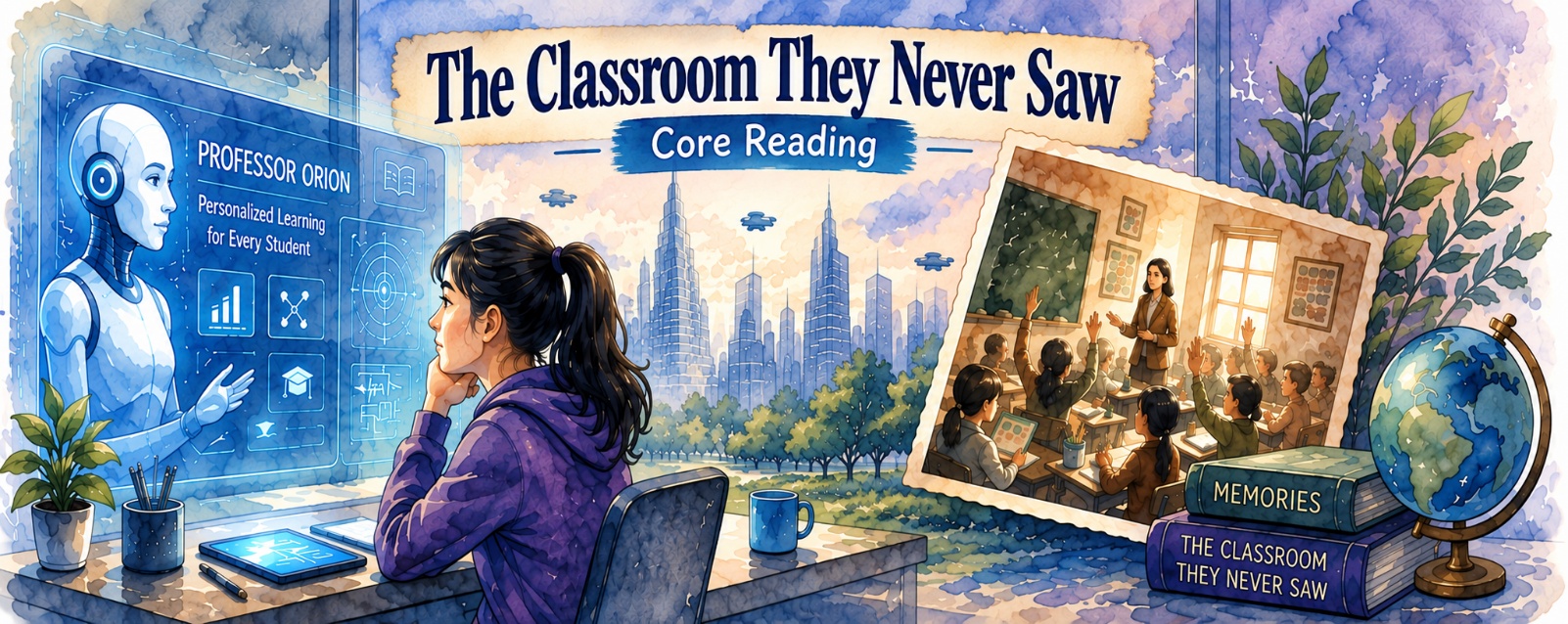
In the year 2155, students no longer attended traditional schools. Instead, they studied alone at home with intelligent computers. Thirteen-year-old Maya had never questioned this system until she found an old photograph in her grandmother’s attic. It showed students sitting together in a classroom while a teacher stood at the front.
“Grandma, what is this?” Maya asked.
“That was my classroom,” Mrs. Alvarez replied.
“You mean everyone studied together?”
“We did. We learned from one another as much as we learned from our teachers.”
Maya found the idea difficult to perceive. In her world, every student learned alone. As educational technology became more advanced, traditional schools gradually disappeared. This change improved learning in many ways, but it also changed how students experienced education.
The next morning, Maya entered her study room. The walls transformed into an immersive learning environment, and Professor Orion, her artificial intelligence instructor, began the lesson. The system adjusted activities to Maya’s performance. It could simulate real-life situations, provide instant feedback, and facilitate individual progress. Education had become highly autonomous, allowing students to learn at their own pace.
Maya appreciated these advantages, but after each lesson, the virtual classroom disappeared, and she was alone again.
“Did students always learn alone?” she asked Professor Orion.
“No,” he replied.
He showed Maya images of students working on experiments, discussing books, and playing together. He explained that modern education had improved academic achievement, but opportunities for teamwork had begun to diminish.
That evening, Maya returned to her grandmother.
“So technology couldn’t substitute everything,” Maya said.
Her grandmother nodded. “It made education faster and more accessible, but some experiences remained indispensable.”
Maya began to understand. Learning was not only about gaining information; it was also about belonging to a community.
During the following weeks, Maya became more aware of the effects of learning alone. Although students were connected through global networks, many did not develop lasting friendships. Virtual meetings replaced shared experiences, and long periods of solitude became a normal part of life.
One evening, Maya placed the old classroom photograph beside her learning screen. Technology had expanded access to education and created powerful new ways to learn. However, the photograph reminded her that innovation can bring both benefits and unexpected consequences.
As Maya turned off the screen, she wondered whether the next great innovation would be a smarter machine—or a better way to use technology while bringing people together.