Currently Empty: $0.00

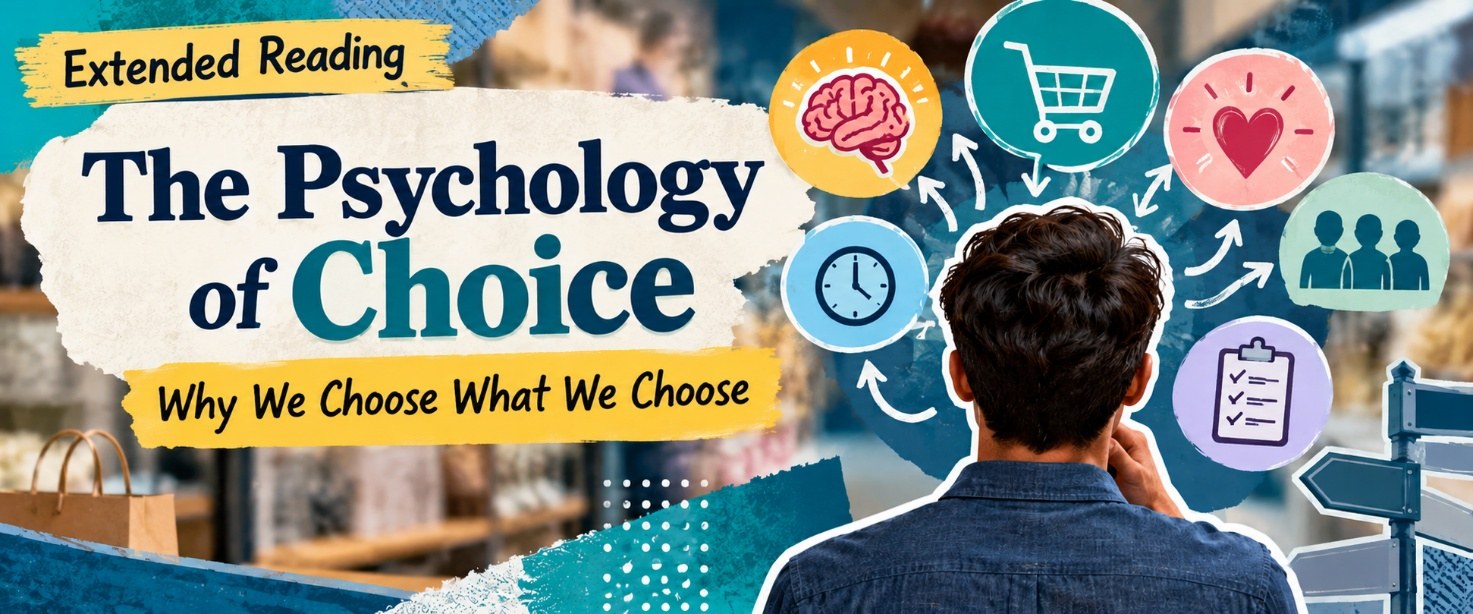
How much control do we have over the choices we make?
Genre: Informational Text
Text Structure: Cause and Effect
Main Reading Skill: Analyze Cause-and-Effect Relationships
Imagine that you are buying a new laptop. You compare several models, read reviews, check prices, and finally select one. The decision feels carefully reasoned and entirely your own. But why did you pay attention to certain reviews and ignore others? Why did one price seem reasonable? Did you choose a particular brand because it was genuinely better, or because you had bought it before?
Questions like these have interested psychologists for decades. People often think of decision-making as a rational process: gather information, examine the available options, and choose the best one. In reality, our decisions are shaped by habits, emotions, patterns of thinking, social influences, and the context in which choices appear. These factors do not eliminate personal choice, but they can influence what attracts our attention and how we judge our options.
One powerful influence is habit. The brain has limited attention, so repeated behaviors gradually require less conscious thought. A familiar response can eventually feel almost instinctive. This is useful. Imagine having to reconsider every morning how to brush your teeth, prepare breakfast, or travel to work. Familiar routines save time and mental energy, allowing us to focus our attention elsewhere.
However, the same efficiency can have disadvantages. A commuter may continue taking the same route even after a faster one becomes available. A customer may keep paying for a service that is rarely used because renewing it requires no action, while canceling it requires a fresh decision. In such cases, habit reduces the chance that a person will stop and consider an alternative. What began as a useful choice can continue simply because it is familiar.
Emotion can produce a different effect. Consider an online store announcing, “Only two left!” or “Sale ends in ten minutes!” A customer who fears missing an opportunity may purchase immediately. If that same person returned to the website the next morning, the product might seem far less necessary. The information has barely changed; the emotional state has.
This does not mean that emotions prevent good decisions. Fear can warn us of danger, enthusiasm can encourage action, and affection can help us recognize what matters to us. Problems arise when a temporary emotion receives more weight than other relevant information. Strong feelings can narrow attention, causing people to focus on immediate rewards or risks while giving less consideration to longer-term effects. As a result, a decision that feels reasonable in one emotional state may appear questionable later.
Patterns of thinking can also shape choice. Psychologists use the term bias to describe a tendency that affects how people process information and form judgments. One common pattern is to favor information that supports an existing belief. Someone convinced that a particular exercise program is highly effective may remember positive reviews while quickly dismissing negative ones. Because people often interpret evidence through their existing beliefs, their judgment may feel fair even when it is not completely impartial.
The way information is presented can have a similar effect. Imagine seeing a coat priced at $180 after first seeing one for $400. The $180 coat may appear inexpensive. But if the first coat had cost $80, the same $180 price might suddenly seem high. Nothing about the second coat has changed. What has changed is the point of comparison. This shows how context can influence the perceived value of an item even when the facts themselves remain the same.
Other people provide another powerful source of influence. When we are uncertain, we often use their behavior as information. A busy restaurant may appear more attractive than an empty one. A book with thousands of positive ratings may seem more trustworthy than one with only a few reviews. This response can be sensible: other people’s experiences may provide useful evidence when we lack direct knowledge.
Yet popularity and quality are not always the same. A person may select a product because friends use it, join a crowded line without knowing what people are waiting for, or accept an opinion because it is widely repeated. When uncertainty increases, the behavior of the group may become more persuasive. Social influence can therefore help people make decisions, but it can also discourage them from examining an option independently.
Most importantly, these causes rarely operate separately. Return to the laptop buyer. The customer may prefer a familiar brand because of habit, feel excited by a limited-time discount, focus on reviews that support an existing preference, and notice that the model is described as a bestseller. Several influences can therefore push the same decision in one direction, making the final choice feel more obvious than it really is.
Can people protect themselves from these influences? Complete independence is probably neither possible nor desirable. Habits make everyday life efficient, emotions communicate important information, and other people’s experiences can help us make informed choices. The more useful goal is to recognize how these forces operate.
A deliberate decision-maker might pause before an important choice and ask: Why does this option seem attractive? What alternative have I overlooked? Is my current emotional state affecting my judgment? Am I giving too much weight to my first impression? Would I reach the same conclusion in a different context? What evidence might challenge my current view?
Such questions do not guarantee perfect decisions. They do, however, interrupt instinctive responses and create an opportunity to examine information more carefully. Understanding the psychology of choice therefore leads to an important conclusion: greater control does not come from eliminating every influence. It comes from recognizing those influences, understanding their effects, and deciding when they deserve to guide us.