Currently Empty: $0.00

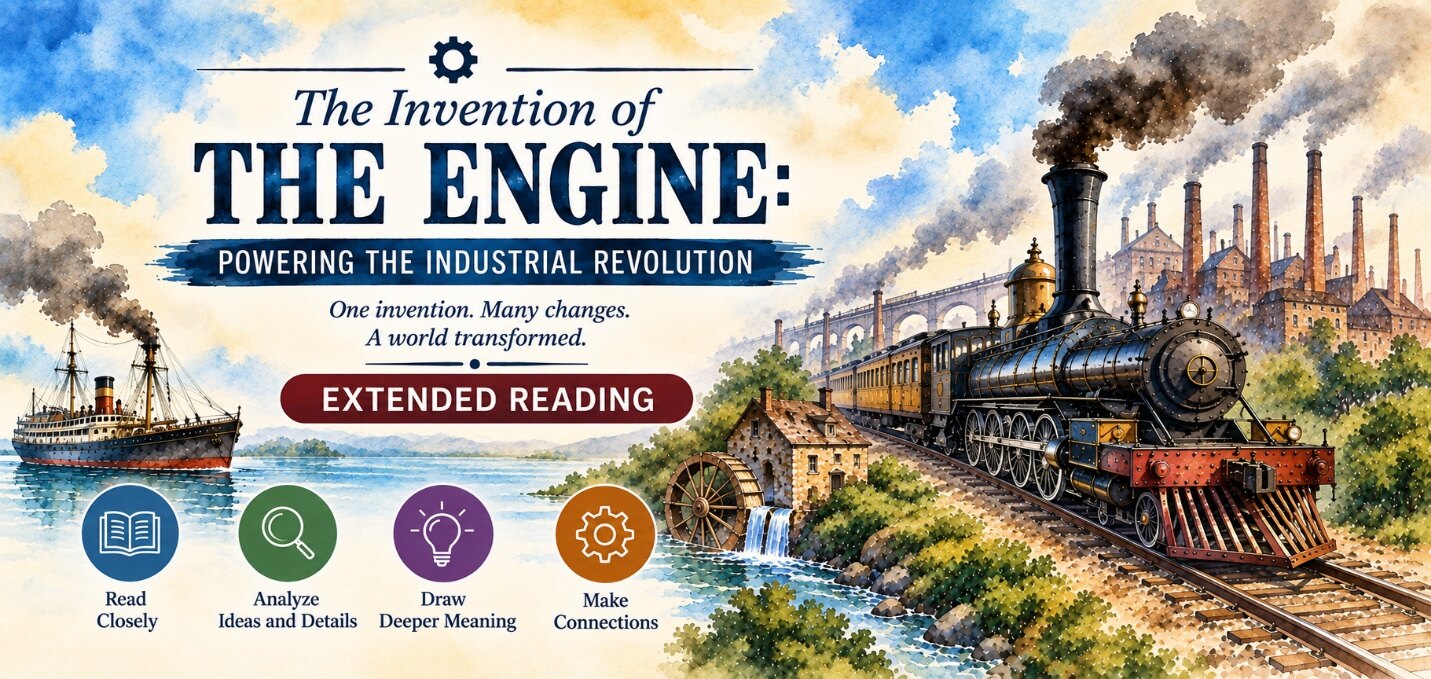
How do inventions change the way people live and shape history?
Genre: Informational Text
Text Structure: Cause and Effect
Imagine a world without cars, trains, airplanes, or factories. Traveling long distances would take weeks instead of hours, and producing everyday goods would require much more time and effort. Before the invention of the modern engine, people relied on human strength, animals, and natural sources of energy such as wind and flowing water. However, these traditional sources of power could no longer meet the needs of growing populations and expanding trade. As a result, the invention of the engine became one of history’s greatest innovations because it transformed transportation, manufacturing, and society, creating effects that continue to shape the modern world.
For centuries, farmers plowed their fields with animals, merchants transported goods by horse and wagon, and ships depended on favorable winds to cross the oceans. Watermills and windmills supplied power for simple tasks, but they were not always reliable because they depended on weather conditions. As populations increased and trade continued to expand, these traditional methods became less effective. Engineers therefore searched for a stronger and more efficient source of power. A major breakthrough came in the early eighteenth century with the development of the first practical steam engine. Later, Scottish engineer James Watt improved its design, making it more powerful and dependable.
The invention of the engine greatly improved transportation. Before steam-powered vehicles, traveling long distances was slow, expensive, and often unpredictable. Because steam trains no longer depended on horses or favorable weather, they transported passengers and goods much faster than before. Railways connected cities that had once been separated by long and difficult journeys, making travel easier and encouraging trade between regions. Steamships produced similar results because they no longer relied entirely on the wind. As a result, businesses reached new markets, international trade continued to expand, and communication between countries became faster and more dependable. These developments transformed transportation and connected people and economies more closely than ever before.
The engine also changed manufacturing by speeding up production and making it more efficient. Before factories became common, skilled workers manufactured products by hand in small workshops or at home. Producing large quantities of goods was slow, expensive, and required considerable effort. Because steam engines powered large machines, factories could produce goods much faster and more efficiently. Consequently, production increased, businesses expanded, and many everyday products became more affordable for ordinary families. Clothing, tools, and household goods that had once been expensive could now be purchased by many more people. These improvements supported economic growth and increased people’s standard of living.
Industrialization also changed society in both positive and negative ways. Because factories needed large numbers of workers, many people moved from rural areas to cities in search of employment. Urban populations grew rapidly, but housing and working conditions often failed to keep pace with this growth. Many factory workers faced long hours, dangerous machinery, and unsafe workplaces. In some regions, children also worked in factories because their families needed additional income. As a result, governments gradually introduced labor laws to improve working conditions and protect workers’ rights. These changes showed that technological progress often requires social progress as well.
The invention of the engine changed much more than transportation and manufacturing. It increased productivity, supported economic growth, and helped societies expand through trade and industry. At the same time, engines powered by fossil fuels also produced harmful emissions, encouraging engineers today to develop cleaner technologies and renewable sources of energy. The history of the engine reminds us that a single innovation can transform the world in remarkable ways. Understanding its effects helps us appreciate how inventions continue to shape our lives and influence future generations.