Currently Empty: $0.00
How do inventions change the way people live and shape history?
Genre: Science Fiction Short Story
Text Structure: Cause and Effect
Imagine attending school without ever leaving your home. There are no classrooms, no school buses, no crowded hallways, and no teachers writing on a whiteboard. Instead, every lesson is delivered by an intelligent computer that understands exactly what you know and what you need to learn next. In the year 2155, this was simply the way education worked.
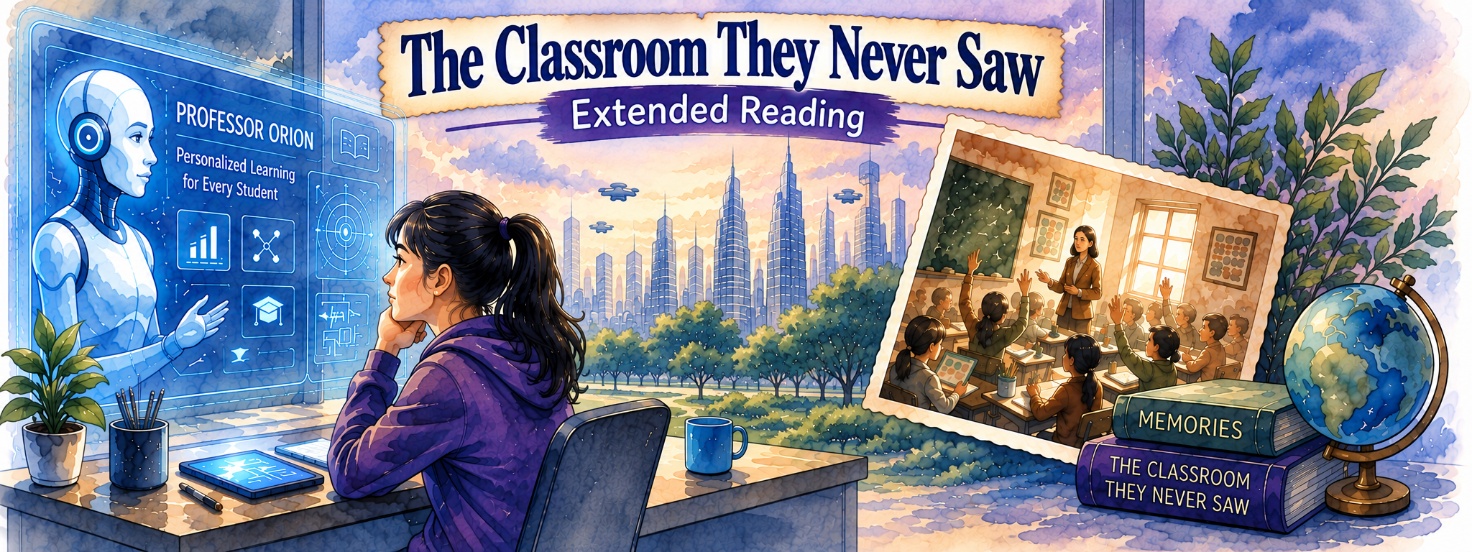
Thirteen-year-old Maya had never questioned this system until the afternoon she discovered an old photograph inside a wooden box in her grandmother’s attic. It showed a room filled with smiling students sitting side by side, their hands raised eagerly while a teacher stood at the front of the classroom. Maya stared at the picture for several moments. She had never seen so many children learning together in the same place.
“Grandma,” she asked, “what is this?”
Mrs. Alvarez smiled as she carefully held the faded photograph.
“That,” she replied softly, “was my classroom.”
Maya looked surprised.
“You mean everyone studied together every day?”
“We did,” her grandmother answered. “We learned from one another as much as we learned from our teachers.”
Maya found the idea difficult to perceive. In her world, every student learned alone.
As educational technology became more advanced, traditional schools gradually disappeared. This transformation led to remarkable improvements in learning, but it also changed how young people experienced education.
The following morning, Maya entered her study room as usual. The walls immediately transformed into an immersive learning environment. Mountains, rivers, and forests surrounded her as today’s geography lesson began.
“Good morning, Maya,” said Professor Orion, her artificial intelligence instructor. “Today’s lesson has been adjusted according to yesterday’s performance.”
Every activity responded instantly to Maya’s answers. When she solved a problem quickly, the lesson became more challenging. When she struggled, additional explanations appeared immediately. The intelligent system could simulate real-life situations, answer complex questions, and provide instant feedback. Each lesson was carefully designed to facilitate individual progress.
Maya appreciated the freedom this system offered. She learned at her own pace, explored topics that interested her, and completed lessons without unnecessary interruptions. Education had become highly autonomous, allowing every student to follow a unique learning path.
Yet something unexpected happened after each lesson ended.
The classroom disappeared.
The mountains faded.
The voices became silent.
Only Maya remained in the room.
One afternoon, she asked Professor Orion,
“Did students always learn alone?”
“For more than seventy years,” the artificial intelligence replied.
“Were schools different before that?”
“Yes.”
“How?”
Professor Orion projected historical images across the room. Students were working together on science experiments, discussing books, laughing during lunch, and playing games in the schoolyard.
Maya watched quietly.
“They look happy,” she whispered.
“They benefited from daily social interaction,” Professor Orion explained. “Modern education improved academic achievement, but some researchers believe opportunities for teamwork gradually began to diminish.”
That evening, Maya returned to her grandmother’s house carrying the old photograph.
“Were classrooms really that noisy?” she asked with a smile.
Mrs. Alvarez laughed.
“Sometimes they were.”
“Didn’t that make learning difficult?”
“Occasionally,” her grandmother admitted. “But every conversation taught us something. We learned patience, respect, confidence, and how to solve problems together. Those lessons could not always be measured by examinations.”
Maya studied the photograph once again.
“So, technology couldn’t substitute everything.”
Mrs. Alvarez nodded thoughtfully.
“It made education faster and more accessible. But some experiences remained indispensable.”
Maya remained silent.
For the first time, she understood that learning was more than mastering information.
It was also about belonging to a community.
During the following weeks, Maya noticed things she had never considered before. After finishing each lesson, she felt the quietness of her room more deeply than before. Although millions of students were connected through global learning networks, very few formed lasting friendships. Digital discussions replaced playground conversations, and virtual meetings replaced shared experiences. Academic success continued to improve, but long hours of solitude became an accepted part of everyday life.
One evening, Maya placed the old classroom photograph beside her learning screen.
The photograph represented the past.
The screen represented the future.
She looked at both for a long time.
Technology had opened doors that previous generations could scarcely imagine. It had expanded knowledge, removed barriers to education, and allowed students everywhere to reach their full potential. Yet the faded photograph reminded Maya that some of life’s most valuable lessons could never be downloaded, programmed, or perfectly simulated.
As she turned off the screen, one question remained in her mind.
Perhaps the greatest innovation of the future would not be inventing smarter machines—but discovering how to bring people back together while continuing to move forward.